Available at all major booksellers: January 13, 2026
Praise for The Battle for Brazil
From a desert death march in North Africa to the war-torn beaches of Bahia, The Battle for Brazil: Resistance, Renewal, and the War Against the Dutch, 1580–1654 integrates Portuguese prophecy, myth, and tradition with on-the-ground action. A remarkable moment in an enduring global contest, the Dutch challenge for Brazil was sparked by the 1580 Spanish claim of the Portuguese throne. The Netherlanders, already locked in battle against Habsburg Spain, turned on their old trading partners, and Portuguese trading posts fell to the Dutch East India Company’s relentless assaults. Then the Dutch turned west—to Brazil. In 1624, Portuguese soldiers, priests, and their indigenous allies pinned invading Dutch West India Company troops to the town of Salvador, Bahia. The following year, a joint Luso-Spanish armada helped oust the Dutch—a short-lived interlude in the battle for Brazil (1630–1654). As town by town fell to the enemy, and as the West India Company expanded control over the Brazilian northeast, it seemed that the contested colony would go Dutch.
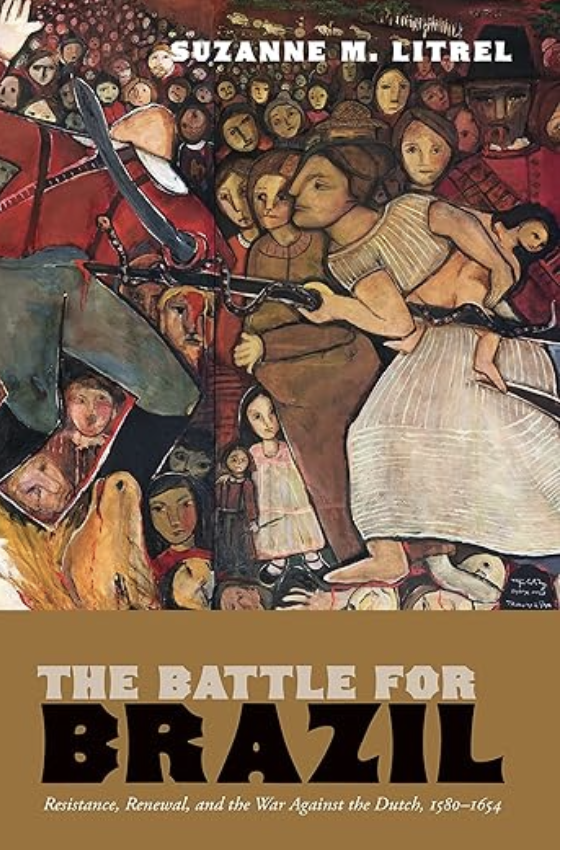
Cover Art: detail of “Mulheres de Tejucupapo” (Tereza Costa Rêgo, 2015).
With permission, family of Tereza Costa Rêgo.
The full image of the mural is in Chapter IV, “Mistress, Mother, Soldier, Spy.”
By the end of 1640, the restoration of an independent Portugal ended sixty years of Spanish rule, but this did not end the kingdom’s trials. With Dom João IV of Braganza on the throne, the kingdom of Portugal now faced a two-front challenge—at home, from Spain, and abroad, from the Dutch. Within five years, lackluster support from Lisbon prompted a new phase of local resistance against the Dutch in Brazil.
This defiance manifested in what would become known as the “Divine War of Liberation”—and with it, an emergent Luso-Brazilian identity. On the ground, cross-class and transatlantic alliance and coordination, formed in the first Dutch assault, only strengthened during the next nine years. The Battle for Brazil highlights the actions of once-marginalized men and women of European, African, Indigenous, and mixed descent who helped force final Dutch surrender by 1654. On both sides of the Atlantic, the battle for Brazil proved a spiritual venture and a reckoning, shaping a new world to come.
 Suzanne M. Litrel, Ph.D.